CORAL REEF BLEACHING - CARIBBEAN: TEMPERATURE RELATED
*****************************************************
A ProMED-mail post
<http://www.promedmail.org>
ProMED-mail is a program of the
International Society for Infectious Diseases <http://www.isid.org>
Date: Thu 14 Oct 2010
Source: ScienceNow [edited]
<http://news.sciencemag.org/sciencenow/2010/10/caribbean-coral-die-off-could-be.html>
Scientists studying Caribbean reefs say that 2010 may be the worst year ever for coral death there. Abnormally warm water since June appears to have dealt a blow to shallow and deep-sea corals that is likely to top the devastation of 2005, when 80 percent of corals were bleached and as many as 40 percent died in areas on the eastern side of the Caribbean.
Bleaching occurs when crucial microorganisms leave coral reefs during stress. Corals, which shelter a quarter or more of all marine species, get bleached, and may die, after prolonged heating. A few weeks of water temperatures a few degrees above normal can be fatal.
During the 2005 die-off, for example, water temperatures off the Virgin Islands rose just 3 deg C above the average in August-but stayed that way until November. "There has been little recovery in the Caribbean since," says reef specialist C Mark Eakin of the US National Oceanic and Atmospheric Administration (NOAA) in Silver Spring, Maryland.
In July of last year [2009], NOAA warned that bleaching was again likely. Now, temperature maps indicate that the water has remained hot for longer than in the 2005 episode and the abnormal warmth spreads over a much broader area (see images at <http://news.sciencemag.org/sciencenow/assets/2010/10/14/sn-coral2.jpg>).
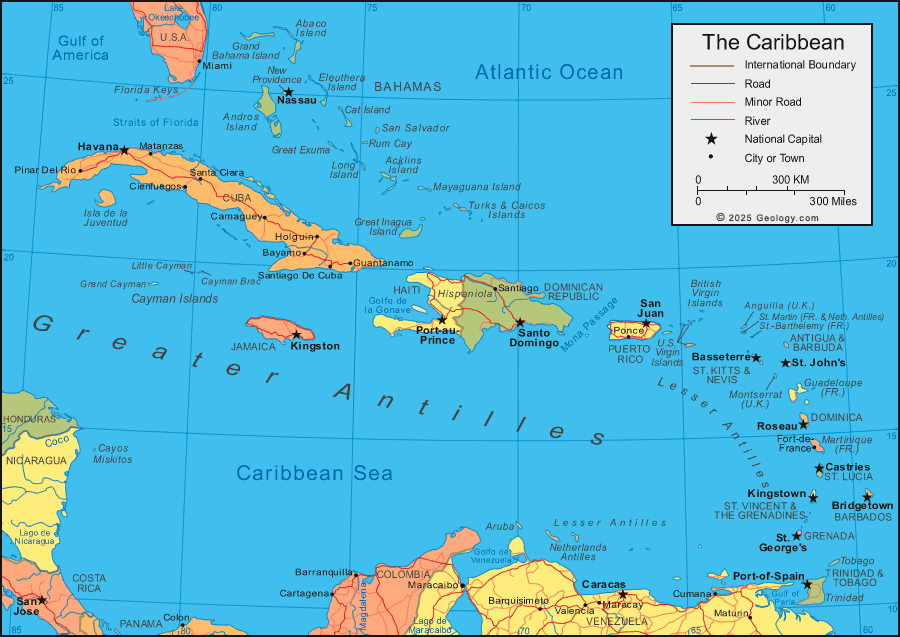
The episode 5 years ago hit the Lesser Antilles on the eastern side of the Caribbean as far south as Guadeloupe. This year [2010], the bleaching and high temperatures have devastated reefs in the Dutch Antilles and affected coral along the western and southern sides of the sea. Those include reefs off Panama and the island of Curacao near Venezuela. That island's maximum monthly average surface water temperature is 28.5 deg C [83.3 deg F]; it was 30.2 deg C [86.4 deg F] for the month of September [2010].
"I've never seen bleaching like [it] in Panama," said Nancy Knowlton, a coral biologist at the Smithsonian Tropical Research Institute in Panama who has been studying the local flora for 25 years. She and colleague Hector Guzman have seen massive reefs die in recent weeks in the enclosed lagoon of Bocas del Toro in Panama after becoming coated with giant sheets of slime, the remains of dead microorganisms. "This is NOT a normal condition on reefs, even bleached reefs. Where last year [2009] there were healthy corals, this year [2010] there was only gray ooze," she wrote in an e-mail.
A lack of wind prevents the mixing that would add cool water and alleviate the die-off. In some areas, says Guzman, the water "is like a Jacuzzi" and the sea life is dead, extra salty, and low in needed dissolved oxygen. "I'm trying to be positive," says Guzman, who notes that some wind has remixed and cooled the waters. "I have seen reefs get wiped out and come back the next year." But the devastation is "more dramatic" than he has seen before, affecting hard corals, sponges, and sea anemones.
A number of factors besides water temperature can cause coral bleaching and die-offs, including pollution and storms. But temperature is the number-one culprit in such a massive die-off, says Eakin. The warmest 12-month period in the NASA temperature record ended this summer [2010]; June through August was the 4th warmest such period in the record. The extent of the devastation across the Caribbean will become clear in the coming months as biologists measure the deaths.
[Byline: Eli Kintisch]
*This article has been corrected. In 2009, NOAA warned in 2009 that coral bleaching was likely to happen again, not in 2010.
--
Communicated by:
ProMED-mail
<promed@promedmail.org>
[Corals live in very nutrient poor waters and have certain zones of tolerance to water temperature, salinity, UV radiation, opacity, and nutrient quantities.
Scleractinian corals build skeletons of calcium carbonate sequestered from the water. When the coral polyp dies, this skeleton remains incorporated in the reef framework.
Scleractinian corals are in the phylum Cnidaria, and they receive their nutrient and energy resources in 2 ways: they use the traditional cnidarian strategy of capturing tiny planktonic organisms with their nematocyst capped tentacles, as well as having an obligate symbiotic relationship with a single cell algae known as zooxanthellae. Zooxanthellae are autotrophic microalgae belonging to various taxa in the phylum Dinoflagellata.
Zooxanthellae live symbiotically within the coral polyp tissues and assist the coral in nutrient production through its photosynthetic activities. These activities provide the coral with fixed carbon compounds for energy, enhance calcification, and mediate elemental nutrient flux. The host coral polyp in return provides its zooxanthellae with a protected environment to live within, and a steady supply of carbon dioxide for its photosynthetic processes. The symbiotic relationship allows the slow growing corals to compete with the faster growing multicellular algae because of the tight coupling of resources and the fact that the corals can feed by day through photosynthesis and by night through predation.
The tissues of corals themselves are actually not the beautiful colors of the coral reef, but are instead clear. The corals receive their coloration from the zooxanthellae living within their tissues.
Bleaching, or the paling of zooxanthellate invertebrates, occurs when
(1) the densities of zooxanthellae decline and/or (2) the concentration of photosynthetic pigments within the zooxanthellae fall (Kleppel et al. 1989). Most reef-building corals normally contain around 1-5 x 10 to the 6th zooxanthellae per cm squared of live surface tissue and 2-10 pg of chlorophyll a per zooxanthella.
When corals bleach they commonly lose 60-90 percent of their zooxanthellae and each zooxanthella may lose 50-80 percent of its photosynthetic pigments (Glynn 1996). The pale appearance of bleached scleractinian corals and hydrocorals is due to the cnidarian's calcareous skeleton showing through the translucent tissues (that are nearly devoid of pigmented zooxanthellae).
If the stress-causing bleaching is not too severe and if it decreases in time, the affected corals usually regain their symbiotic algae within several weeks or a few months. If zooxanthellae loss is prolonged, that is, if the stress continues and depleted zooxanthellae populations do not recover, the coral host eventually dies.
The article does not tell us of alkalinity of the water, only temperatures. If temperatures are the only cause, which is highly unlikely, are hurricanes then a productive thing as they bring rain and prevent the temperatures from going too high?
Portions of this comment have been extracted from <http://www.marinebiology.org/coralbleaching.htm>. - Mod.TG]
[Maps of the region are available at
<http://geology.com/world/caribbean-map.gif> and <http://healthmap.org/r/0dZi>. - Sr.Tech.Ed.MJ]
[see also:
Montipora white syndrome, coral reef - USA (02): (HI) 20100415.1220 Montipora white syndrome, coral reef - USA: (HI) 20100403.1078
2007
----
Vibrio, rare coral - UK 20070905.2933
Coral reef kill - Costa Rica 20070904.2915 Coral reef kill - Pacific Region 20070810.2600
2004
----
Coral reef kills - USA (FL) (02) 20040327.0846 Coral reef kills - USA (FL) 20040320.0777
2002
----
Coral reef kills, unknown etiology - Australia 20021023.5624 Coral reef kills, human waste suspected - Caribbean 20020627.4622 2000
----
Coral reef kills - Belize 20000510.0713
1999
----
Coral reef kills & potential human disease (02) 19990204.0161 Coral reef kills & potential human disease 19990124.0111
1998
----
Coral reef bleaching & El Nino - Indian Ocean (02) 19981113.2187 Coral reef bleaching, El Nino effects - Indian Ocean 19980705.1246 Coral reef kills, etiology determined - USA 19980415.0693
1996
--
White pox, coral reefs - Florida, USA (02) 19961231.2165 White Pox, coral reefs - Florida, USA 19961228.2160] ...................................sb/tg/mj/lm/ll
*##########################################################*
************************************************************
ProMED-mail makes every effort to verify the reports that are posted, but the accuracy and completeness of the
information, and of any statements or opinions based
thereon, are not guaranteed. The reader assumes all risks in
using information posted or archived by ProMED-mail. ISID
and its associated service providers shall not be held responsible for errors or omissions or held liable for any damages incurred as a result of use or reliance upon posted or archived material.



0 comments:
Post a Comment