UNDIAGNOSED FEATHER LOSS, PENGUINS - SOUTH AFRICA, ARGENTINA: REQUEST FOR INFORMATION
*************************************************************************************
A ProMED-mail post
<http://www.promedmail.org>
ProMED-mail is a program of the
International Society for Infectious Diseases <http://www.isid.org>
Date: Fri 8 Apr 2011
Source: New Scientist [edited]
<http://www.newscientist.com/blogs/shortsharpscience/2011/04/penguins-go-bald-thanks-to-mys.html>
Something is causing young penguins in South Africa and Argentina to lose their feathers.
The condition was first seen in black-footed penguins in a rehabilitation centre in South Africa in 2006. The following year it was found in wild Magellanic penguins, living on the other side of the Atlantic in Argentina. Wild penguins in South Africa have also been affected.
It has been seen in chicks, who normally go through several moults before growing their adult plumage. In both species, chicks did not immediately replace one coat after moulting, and instead spent several weeks partially or wholly bald. If they survived, the chicks did eventually grow a new coat, but in the interim being bald put them at increased risk of exposure (Waterbirds (2010) 33(3): 415-21).
Nola Parsons of the Southern African Foundation for the Conservation of Coastal Birds in Cape Town, where the condition was first seen, says it is probably caused by an infection: there is no evidence for a parasite, malnutrition, or stress.
But the culprit has proven elusive, so last year [2010] Parsons took a swathe of samples from affected penguins. She is arranging to send them to Greg Cunningham of St John Fisher College in Rochester, New York, who will try to identify what's causing the disease. Parsons says that so far it is not a major threat: most penguins appear to recover and the condition is not becoming more common. But she points out that it is likely to be an emerging disease, and could escalate.
[Byline: Michael Marshall]
--
Communicated by:
ProMED-mail
<promed@promedmail.org>
[This 1st report of feather-loss disease in African penguins in 2006 and in Argentina in 2007 suggests the disorder is new. For African penguins at the rehabilitation center in 2006, 2007, and 2008, 7 percent, 18 percent, and 11 percent of chicks lost feathers respectively, while feather loss disease is rarer in Magellanic penguins, with only 13 cases found from over 20 000 chicks checked in
2007 and 2008.
Feather loss disorder disrupts the penguins' ability to maintain their body temperatures. Researchers have observed featherless penguins basking in the warm -- but harmful -- midday sun while their feathered cohorts sought protection in the shade. In Antarctic penguins such as the black-footed penguin, feather loss can lead to death from hypothermia.
Penguins with feather loss in this study were found to grow more slowly and are smaller in size and weight than normal penguins. South African featherless chicks took 16 days longer to reach release weight than feathered chicks. Possible causes of feather loss in birds include pathogens, thyroid disorders, nutrient imbalances, or genetics. But the authors of this study believe that malnutrition is not the cause, as the captured penguins were in good body condition, fed appropriate foods, and given vitamin supplements.
It is still unknown whether the feather loss in South African and Magellanic penguins is related or not.
Although unrelated, psittacine beak and feather disease (PBFD) is a viral disease that also causes feather loss in birds. PBFD is caused by the psittacine circovirus and is specific to psittacine birds such as parrots, parakeets, cockatoos, macaws, and lovebirds. Transmission of the virus is through direct contact, inhalation, and ingestion. The virus is very stable in the environment and can survive for many months in feather dust, feces, and nest materials. Symptoms of PBFD are irreversible feather loss, shedding of developing feathers, development of abnormal feathers and coloration, pinched feathers, and loss of powder down [plus gross beak deformities]. There is no specific treatment for PBFD and the disease has now been reported in over 42 wild and captive psittacine species from all continents.
The abstract for the full scientific paper mentioned above, detailing this incident can be accessed at <http://dx.doi.org/10.1675/063.033.0321>.
A map showing Cape Town, South Africa can be found by zooming in at <http://healthmap.org/r/0FUF>.
A map showing the site of Magellanic penguins at Punta Tombo, Argentina can be found at <https://blogger.googleusercontent.com/img/b/R29vZ2xl/AVvXsEhY_VxYooK69qsHCwURTfkXB5NiQwJdT2upFVeePspb1Yqpql22DDeSrNKf86DObbMLiqThn9doUns5LFWFctpaDrR2JE3dhrluBy4eRamYh35HC0ogiYMLSIjenUZbozMQbiFodMANIK0/s1600-r/mapa_punta_tombo.gif>.
- Mod.KL]
[It is to be hoped that Greg Cunningham's lab in New York state will be able to test for a possible new circovirus. ProMED would like to know the diagnosis. Does anybody know if the ranges of the 2 penguin species overlap anywhere, to account for the condition spanning the Atlantic? - Mod.JW]
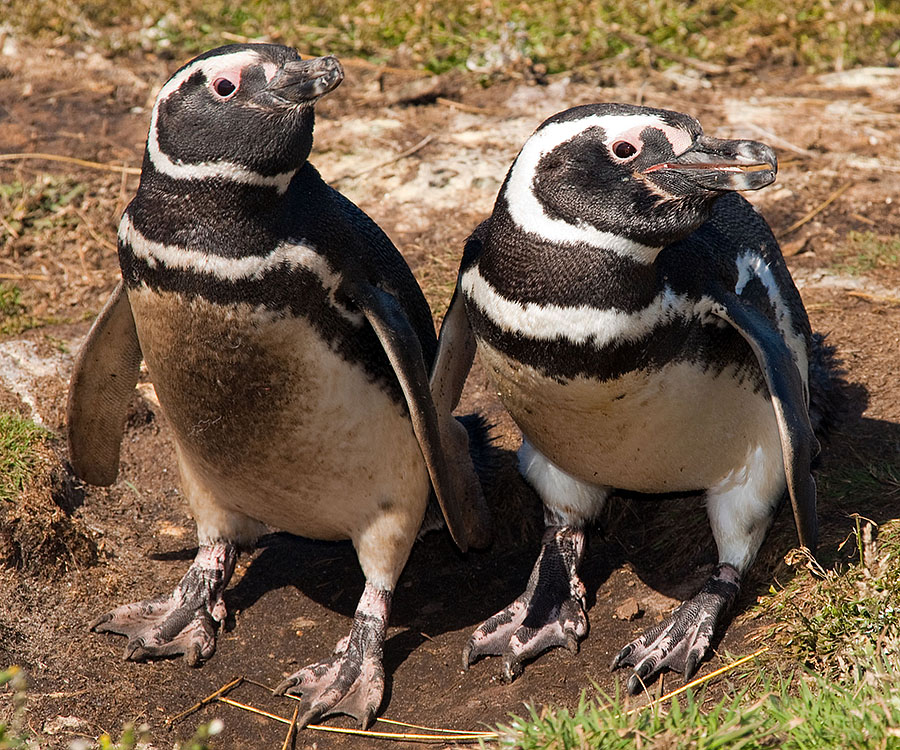
[Magellanic penguins (_Spheniscus magellanicus_) can be seen at <http://www.komar.org/faq/travel/vacation/antarctica/falklands_carcass-island/2009_01_25_5354-falklands_carcass-island.jpg>
and South African Black-footed penguins (_Spheniscus demersus_) at <http://upload.wikimedia.org/wikipedia/commons/4/4b/African_Penguin_(Spheniscus_demersus)_at_London_Zoo.jpg>.
Photos of penguins affected by feather loss disorder can be seen at the source URL above. - Sr.Tech.Ed.MJ]
[see also:
2010
----
Beak & feather disease, parakeets - New Zealand 20100326.0957] .................................................sb/kl/jw/mj/jw/ll
*##########################################################*
************************************************************
ProMED-mail makes every effort to verify the reports that are posted, but the accuracy and completeness of the
information, and of any statements or opinions based
thereon, are not guaranteed. The reader assumes all risks in
using information posted or archived by ProMED-mail. ISID
and its associated service providers shall not be held responsible for errors or omissions or held liable for any damages incurred as a result of use or reliance upon posted or archived material.



0 comments:
Post a Comment