WHIRLING DISEASE, TROUT - USA (04): (UTAH)
******************************************
A ProMED-mail post
<http://www.promedmail.org>
ProMED-mail is a program of the
International Society for Infectious Diseases <http://www.isid.org>
Date: Fri 2 Dec 2011
Source: The Salt Lake Tribune [edited]
<http://www.sltrib.com/sltrib/news/53037842-78/disease-strawberry-whirling-fish.html.csp>
Whirling disease found at Utah's prized Strawberry Reservoir
----------------------------------------------------------
Most anglers and biologists feared that it was inevitable that whirling disease would find its way into Strawberry Reservoir, one of Utah's most important flat-water trout fisheries.
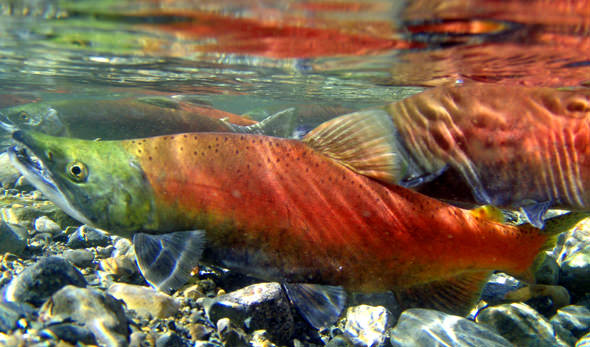
That inevitability occurred this week [week of 28 Nov 2011] when fish pathologists from the Division of Wildlife Resources [DWR] tested 60 kokanee salmon collected at Strawberry and found spores from the parasite in 2 of them.
The good news for anglers is that, while whirling disease is still a major concern, much has been learned about how to counteract its effects on a fishery. The disease was first discovered in Utah in 1991 in a private fish hatchery in Wayne County owned by the family of then-Utah Gov. Mike Leavitt. Whirling disease doesn't harm people. But the disease can be fatal to small trout and salmon. The disease causes infected fish to often swim in a whirling motion before they die, thus giving the disease its name.
"This would have been a much different matter if it had happened in the mid-1990s," said Roger Wilson, chief of the DWR's aquatic section.
"We know a lot more about whirling disease and what happens [to the fish] post infection. It's still a great concern, and we would prefer not have it. We are in a situation where we can live with this parasite, even in a place like Strawberry."
Wilson said biologists expected to find whirling disease at Strawberry sooner. It can be moved by anglers, boats, flowing water, or birds.
The disease was found several years ago in the West Fork of the Duchesne River. Water from the river eventually empties into Strawberry Reservoir through an aqueduct and collector system.
Veteran Utah angler and Fish Tech tackle shop owner Byron Gunderson was not surprised by the discovery. "It was inevitable," he said. "It was just a matter of time. That stuff leaks from here to there, so it wasn't particularly unexpected." Wilson said that the disease affects mostly small trout. Once trout grow from fry to fingerling size, the chances of the fish developing clinical signs of the disease diminish rapidly.
Biologists plant rainbow and cutthroat into Strawberry that are a minimum of 8 inches [20 cm] long, a size not affected by the disease.
And most of the rainbows planted into the big reservoir are a whirling-disease-resistant strain known as Harrison-Hoffer. Wilson said that the agency would expand the use of the strain at Strawberry in the future.
An audit issued to the Utah Legislature on the DWR's hatchery program this week was somewhat critical of the agency for its hatchery program. But Wilson said the way Strawberry is managed shows why the state's hatchery system sometimes needs to produce bigger fish that cost more money. All of the rainbow trout in the reservoir are stocked by the DWR, which also stocks kokanee and cutthroat. In addition, the Bear Lake cutthroat trout planted in Strawberry are also more resistant than some other cutthroat strains.
"All of these things we come up with on the management end make it more difficult on the hatchery system," he said.
Another major concern is how the disease might affect cutthroat and kokanee trout that spawn naturally in Strawberry's tributaries. Those fish also add to the number of fish in the reservoir. Kokanee salmon are particularly susceptible to whirling disease.
Wilson said that 15 to 20 per cent of the adult age cutthroat [trout] produced at Strawberry come from its tributaries, though that percentage has been as high as 65 per cent in the past. An aggressive stream restoration program on the Strawberry River could mean less habitat for the parasite host that causes whirling disease. Most of the cutthroat [trout] caught by anglers, though, are hatchery raised.
"I don't know how successful the spawn has been as far as the cutthroats go," said Gunderson. "Few of my customers ever catch cutthroats. Rainbow planting has been successful because they have been raising fish to a larger size before they grow up."
[byline: Tom Wharton]
--
communicated by:
ProMED-mail from HealthMap alerts
<promed@promedmail.org>
[Whirling disease affects fish in the trout and salmon [Salmonidae] family. By damaging cartilage, whirling disease can kill young fish directly, or cause infected fish to swim in an uncontrolled whirling motion. This can make it impossible for them to escape predators or to effectively seek food.
Whirling disease is caused by a microscopic parasite called _Myxobolus cerebralis_. The parasite was introduced to the United States from Europe in the 1950s and has spread to many streams across the country.
The whirling disease parasite has been found in wild fish and fish hatcheries in 25 states.
Once established in a stream, the parasite cannot be eradicated, nor can its worm host, without significantly damaging the ecosystem.
Whirling disease has no known human health effects. Currently there is no known treatment for affected fish. However, practice management in hatcheries can reduce the risk.
The disease does not affect humans, only fish in the trout and salmon family. The infective stage of the parasite can penetrate human skin and tissues but it does not survive at a human's natural body temperature. Therefore the disease is harmless to humans and even if an infected fish is consumed, it will not affect humans.
The disease can be quite devastating to fish and is a concern for all when it is found in a body of water. Anglers can help by disinfecting boats, boots, lines, live-wells, and other equipment prior to arrival at a new/different body of water.
Portions of this comment were extracted from <http://whirlingdisease.montana.edu/>.
Photos:
Kokanee salmon
<http://fishwithjd.com/wp-content/uploads/2009/11/Koke-Buck.jpg> and <http://www.scn.org/savelake/NL.Spring.2004/NL.Spring.2004_files/kokanee.salmon.jpg>.
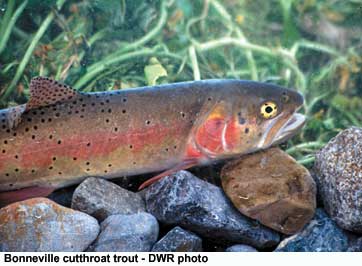
Cutthroat trout
<http://www.animalpicturesarchive.com/ArchOLD-7/1191548820.jpg> and <http://www.redrockadventure.com/adventure/wildlife/i/bonneville_cutthroat.jpg>.
- Mod.TG
Strawberry Reservoir can be located via the HealthMap/ProMED-mail interactive map at <http://healthmap.org/r/1wor>. - Sr.Tech.Ed.MJ]
[see also:
Whirling disease, salmonids - USA (03): (UT) 20110911.2770 Whirling disease, salmonids - USA (02): (UT) trout 20110707.2051 Whirling disease, salmonids - USA: (UT, MD) 20110520.1528
2007
---
Whirling disease, fish - USA (AK) 20070606.1826 Whirling disease, fish - USA (MD) (03) 20070505.1454 Whirling Disease, fish - USA (MD) (02) 20070217.0598 Whirling disease, fish - USA (MD) 20070215.057
2006
---
Whirling disease, fish - USA (UT) 20061214.3517 Whirling disease, fish - USA (OR): transmission 20061105.3175
2005
---
Whirling disease, fish hatchery - USA (UT) 20050429.1194] .................................................sb/tg/mj/sh/ll
*##########################################################*
************************************************************
ProMED-mail makes every effort to verify the reports that are posted, but the accuracy and completeness of the
information, and of any statements or opinions based
thereon, are not guaranteed. The reader assumes all risks in
using information posted or archived by ProMED-mail. ISID
and its associated service providers shall not be held responsible for errors or omissions or held liable for any damages incurred as a result of use or reliance upon posted or archived material.




0 comments:
Post a Comment